Executive Summary
In this brief, we will examine the discrepancy between two terms used in laws and international conventions related to cultural heritage. In the Arabic language, the words 'āthār and turāth are usually used as equivalents of the English words “antiquities” and “heritage.”
These discrepancies create difficulties in applying the international conventions in an efficient way. In addition, it creates difficulties in communication and understanding between the Arab countries, although they speak the same language. Therefore, it is important for Arab countries to collaborate to agree on a common use of terms. In addition, it is important to update national laws related to cultural heritage, as most of them still do not include intangible cultural heritage.
By analyzing the Arab national laws and examining the meaning in the language, we will see that 'āthār does not mean antiquities only. It also includes archaeological sites, while in English, “antiquities” refers exclusively to ancient objects. Similarly, the word turāth usually refers to traditions and objects used in living, folkloric spheres, while “heritage” is a wide concept that includes everything inherited, including antiquities and archaeological sites, as well as traditions and folkloric items or arts.
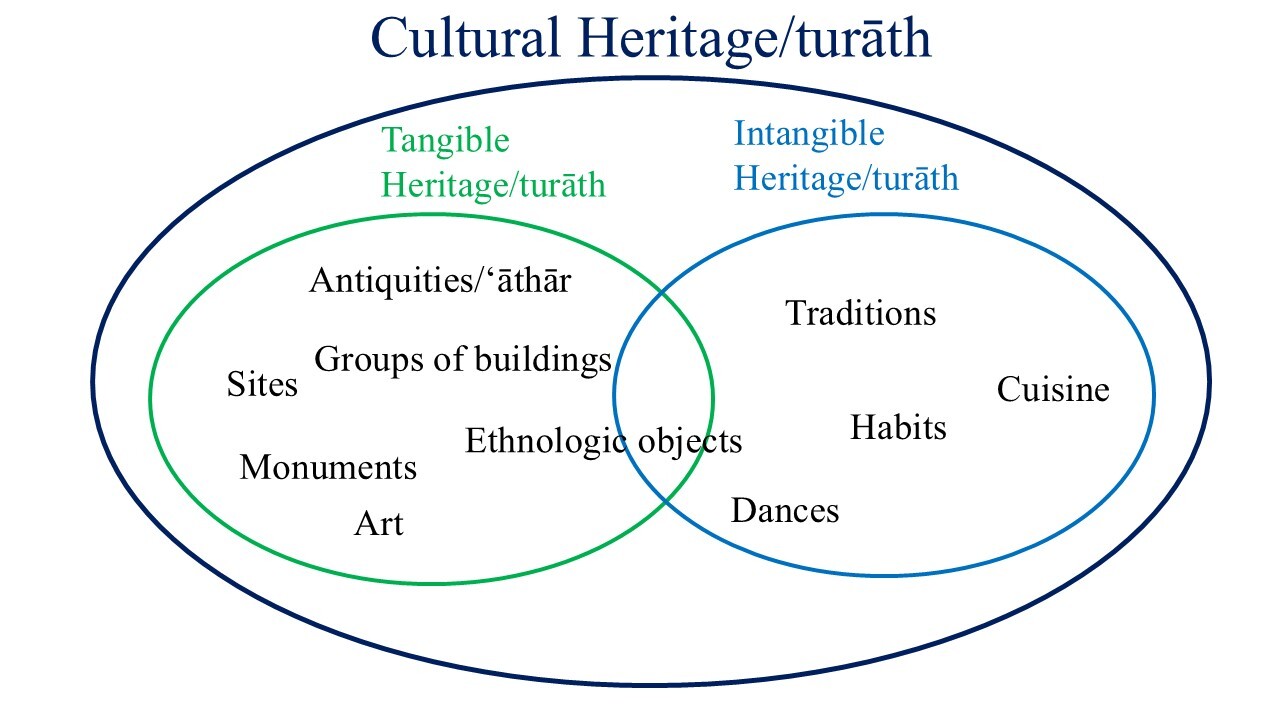
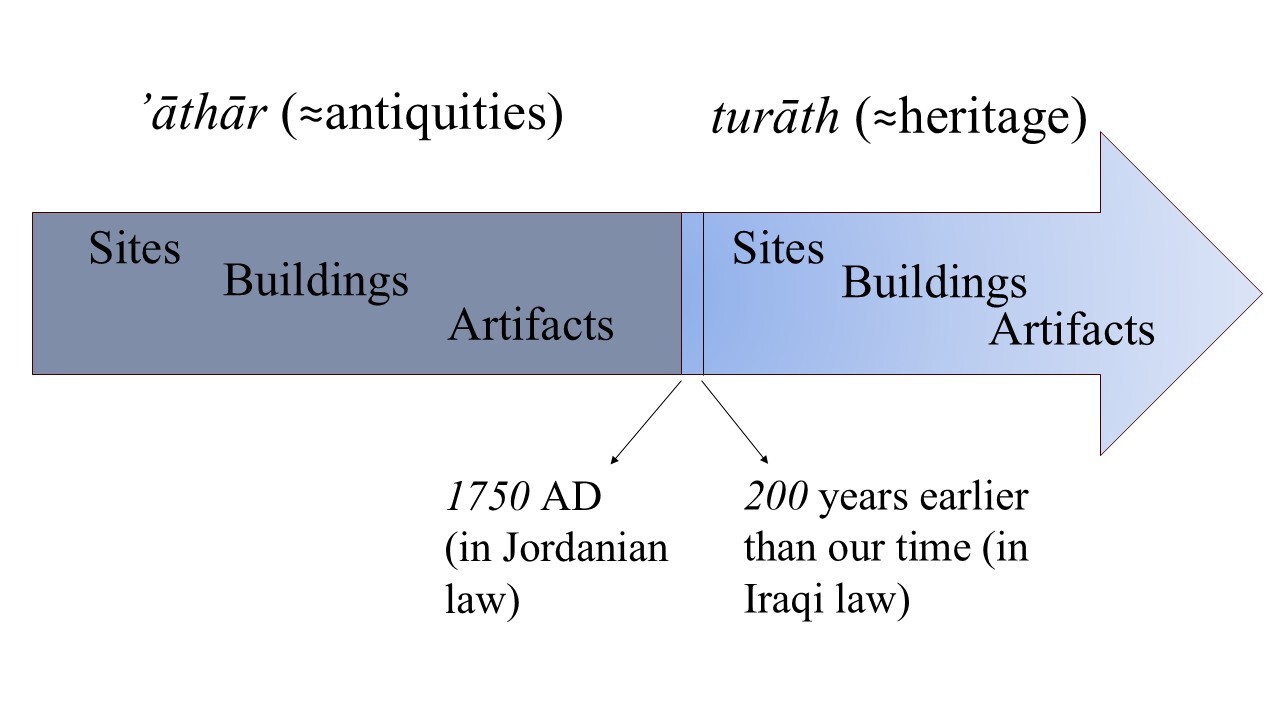
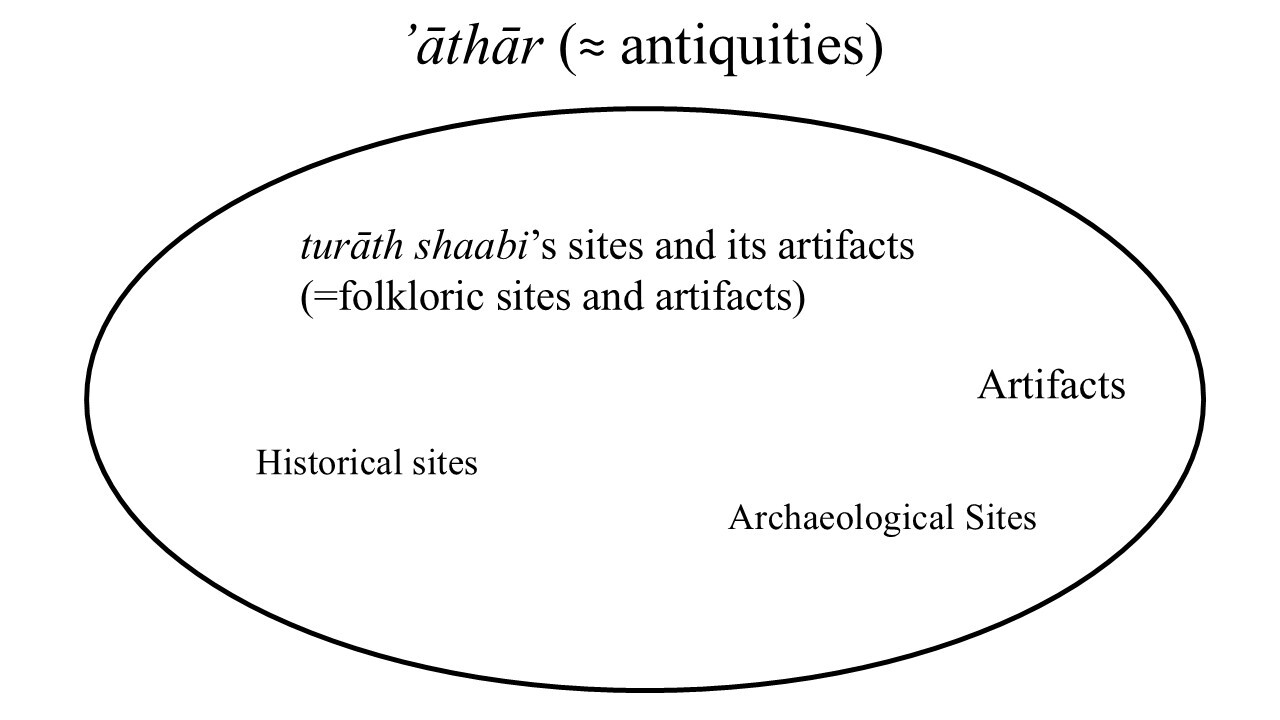
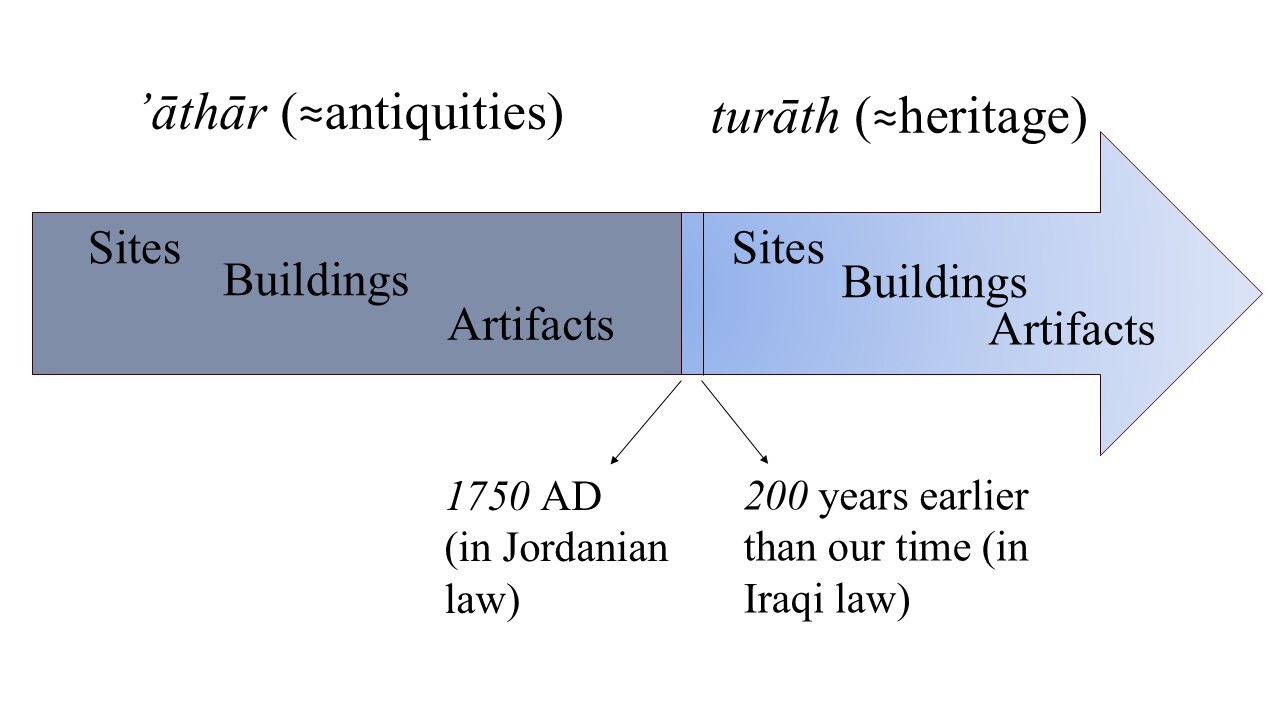
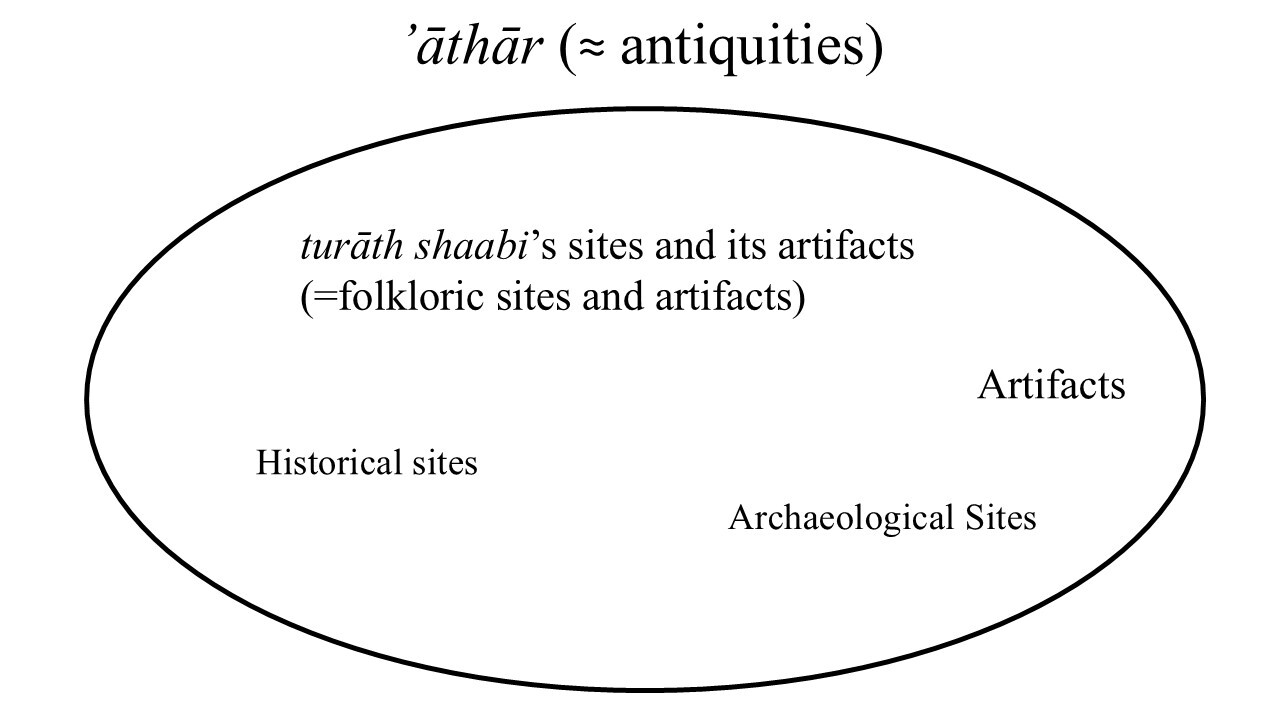
There are also discrepancies between the definitions of 'āthār and turāth among the national laws of the Arab countries. Iraqi law refers to movable or immovable cultural heritage properties as 'āthār if they are before 1750 or older than 200 years and turāth if they are newer (Figure 2). In Omani law, which follows the international conventions, turāth/heritage is a wide term indicating tangible and intangible heritage, including historical sites, literatures, languages and the 'āthār/antiquities (Figure 1). On the other hand, the Saudi law presents the opposite understanding, where 'āthār/antiquities includes turāth/heritage (Figure 3).
Introduction
Two Arabic words are used in the translations of international conventions related to cultural heritage. These words are 'āthār and turāth, which should be equivalent to the two English words “antiquities” and “heritage.” But in Arabic culture, as well as in the national laws of Arab countries, these two words do not have the same conception or definition as antiquities and heritage.
Recently, some Arab countries updated their national laws related to cultural heritage. Some of them adopted the English concepts or definitions for heritage and antiquities, while others kept the popular understanding of these terms.
In this brief, we will see the conceptual relationship between heritage and antiquities or their Arabic equivalents, 'āthār and turāth, by analyzing the national laws of four Arab countries and the international conventions related to cultural heritage.
Heritage and Antiquities in International Conventions
The oldest evidence of the use of the word heritage was around 1225 AD in the Legend of St. Katherine. At the time, the word was used to mean that which has been or may be inherited (OED 2024). Through time, the word took a broader meaning to indicate the collective historical and cultural values that were inherited. The expression “artistic heritage” was used for the first time by Euripide Foundoukidis at the First International Congress of Architects and Technicians of Historic Monuments in Athens in 1931, and the term became commonly used in the documents of international organizations (Vecco 2010, 321).
The first definition for “heritage” was introduced in the 1964 Venice International Charter for the Conservation and Restoration of Monuments and Sites. The Charter’s introduction states:
Imbued with a message from the past, the historic monuments of generations of people remain to the present day as living witnesses of their age-old traditions. People are becoming more and more conscious of the unity of human values and regard ancient monuments as a common heritage. The common responsibility to safeguard them for future generations is recognized. It is our duty to hand them on in the full richness of their authenticity is found (Vecco 2010, 322).
Heritage in the Venice Charter is focused on monuments and not artifacts, but we can find a more inclusive definition of heritage in the UNESCO 1970 Convention on the Means of Prohibiting and Preventing the Illicit Import, Export and Transfer of Ownership of Cultural Property. This Convention lists antiquities more than 100 years old and products of archaeological excavations among the categories of “cultural property” that are part of “cultural heritage” (UNESCO 1970en, Articles 1 and 4). Article 1 states:
(c) products of archaeological excavations (including regular and clandestine) or of archaeological discoveries;
(e) antiquities more than one hundred years old, such as inscriptions, coins and engraved seals; (emphasis mine, UNESCO 1970en, Article 1, c and e).
Instead, the UNESCO 1972 Convention Concerning the Protection of the World Cultural and Natural Heritage includes monuments, inscriptions, groups of buildings, and sites as “cultural heritage.” It states:
Article 1: For the purpose of this Convention, the following shall be considered as “cultural heritage”:
Monuments: architectural works, works of monumental sculpture and painting, elements or structures of an archaeological nature, inscriptions, cave dwellings and combinations of features, which are of outstanding universal value from the point of view of history, art or science.
Groups of buildings: groups of separate or connected buildings which, because of their architecture, their homogeneity or their place in the landscape, are of outstanding universal value from the point of view of history, art or science.
Sites: works of man or the combined works of nature and man, and areas including archaeological sites which are of outstanding universal value from the historical, aesthetic, ethnological or anthropological point of view (emphasis mine, UNESCO 1972, Article 1).
Instead, the intangible cultural heritage was defined in the UNESCO 2003 Convention for the Safeguarding of the Intangible Cultural Heritage. Thus, intangible cultural heritage includes performing arts, traditions, cuisines, and other oral narration or knowledge (UNESCO 2003, Article 2).
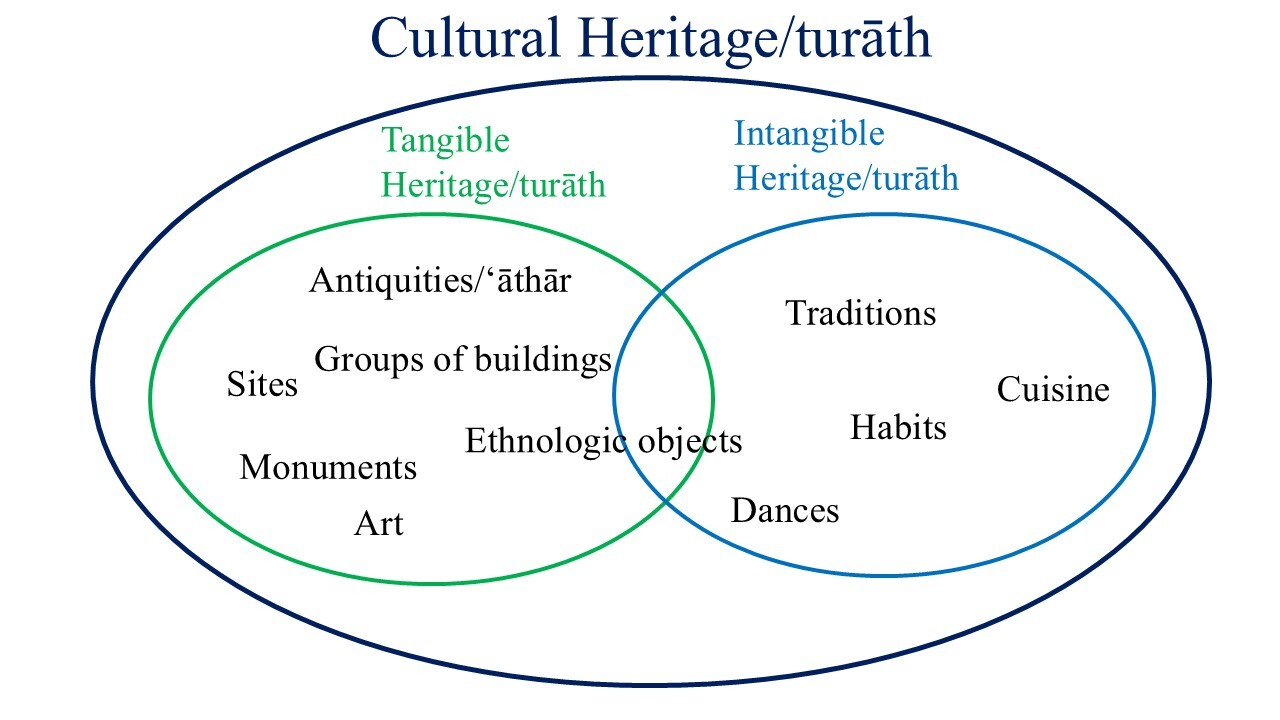
So, we can understand that cultural heritage contains two categories: tangible and intangible cultural heritage. Based on the understanding of the international conventions, we can represent the concept or the definition of cultural heritage as a balloon that contains antiquities, archaeological artifacts, archaeological sites, and buildings or groups of buildings in addition to other items and intangible cultural heritage (Figure 1).
International Conventions in Arabic Versions
As the Arabic language is one of the six official languages of the United Nations, most of the UN’s documents are translated into Arabic language. In the Arabic versions of the international conventions related to cultural heritage, we find two words: turāth and 'āthār. Usually, turāth is equivalent to heritage, while 'āthār is antiquities. According to the Arabic translation of Article 1 of the UNESCO 1970 Convention on the Means of Prohibiting and Preventing the Illicit Import, Export and Transfer of Ownership of Cultural Property that the cultural property contains:
(e) 'Āthār more than one hundred years old, such as inscriptions, coins and engraved seals (emphasis mine, UNESCO 1970ar, Article 1).
Elsewhere cultural property is part of the turāth thaqāfī (UNESCO 1970ar, Article 4).
Based on this, we can represent the relationship between turāth and 'āthār as the relationship between heritage and antiquities where turāth is the big balloon which contains 'āthār and other items (Figure 1).
Definitions of turāth and 'āthār in the Arab World
As we saw in the international convention, turāth is heritage, and 'āthār is antiquities, but is this what we find in the national laws? Here, we would like to examine the national law in four Arab countries: Jordan, Iraq, Saudi Arabia, and Oman.
In Jordan, the national law related to regulating the archaeological excavations, artifacts, and sites is called qānūn al-'āthār, and it was drawn as the Law No. 21 in 1988 and the amending Law No. 23 for the year 2004 (Jordanian Antiquities Law 1988, Article 1). The law contains the definition of 'āthār/antiquities as follows:
a) Any movable or immovable object which was made, written, inscribed, built, discovered or modified by a human being before the year AD 1750, including caves, sculpture, coins, pottery, manuscripts, and other kinds of manufactured products which indicate the beginning and development of science, arts, handicrafts, religions, traditions of previous civilizations, or any part added to that thing or rebuilt after that date.
b) Any movable or immovable object as provided for in clause “a” of this definition which dates after AD 1750 and which the Minister [of Tourism and Antiquities] requests to be considered an 'āthār by a decision published in the Official Gazette (Jordanian Antiquities Law 1988, Article 2, 7).
We do not find any definition for turāth in this law, but we find it in another law, which was issued in 2005, qānūn ḥimayat al-turāth al-ʿimrānī wa al-ḥaḍarī (trans. The Protection of Urban and Architectural Heritage Law). Article 2 of the law defines a turāthic site as any building or site that has turāthic value, whether in terms of style, its relation to an important historical figure, national, patriotic, or religious event, and was built after 1750 AD (Jordan Heritage Law 2005, Article 2).
While in the Jordanian law, turāth is exclusive to urban and building items, which differentiate from 'āthāric buildings, that it is, newer, after 1750 AD, we find in the Iraqi law a more inclusive definition for turāth/heritage and a clearer differentiation from 'āthār/antiquities. Paragraphs 7 and 8 from Article 4 of the Iraqi antiquities law of 2002 states:
7) The 'āthār: It is the movable and immovable property which was built, fractured, sculptured, produced, written, drawn, or figured by a human being dated to more than 200 years ago, in addition to human, animal, and plant remains.
8) The turāth materials: It is the movable and immovable property dated to less than 200 years ago and which has historical, regional, national, religious, or artistic value. It would be announced in a declaration by the minister (Iraqi Antiquities Law 2002, Article 4).
So, we can understand the relationship between turāth/heritage and 'āthār/antiquities as a linear relationship, and neither one contains the other, as in the international definitions (Figure 2).
The same international definitions of turāth/heritage and 'āthār/antiquities are found in the Omani law, which is the most recent of the laws examined here, and probably in the Arab world. Issued in 2019, it also contains the concept of intangible cultural heritage. The law states:
Turāth thaqāfi (cultural heritage) is anything that has cultural heritage importance/significance, whether tangible or intangible, including the 'āthār/antiquities, historical cities, traditional villages, old neighborhoods, literatures and languages (Omani Law of 2019, n.d., Article 1,g).
The turāth/heritage contains the 'āthār/antiquities, so the same relationship exists as in the international conventions (Figure 1).
In the Saudi law, we see that the relationship between the turāth/heritage and the 'āthār/antiquities is the opposite of the Omani or international convention definitions. The law states:
The 'āthār and 'āthār Sites: Movable or immovable, buried or submerged objects, […] not less than 100 years old. However, objects that are less than 100 years old may be considered by SCTA as 'āthār/antiquities. 'āthār/antiquities includes historical and turāth shaabi’s sites and artifacts (emphasis mine, Saudi Law of Antiquities, Museums and Urban Heritage 2014, Article 1).
So 'āthār/antiquities contains archaeological and historical sites, and artifacts older than 100 years. In addition, 'Āthār/antiquities also includes “turāth shaabi’s sites and artifacts,” which we find in the same article, defined as folkloric sites or objects produced or used in “recent periods” (Saudi Law of Antiquities, Museums and Urban Heritage 2014, Article 1).
Policy Implications and Recommendations
As we saw, we have three different definitions for turāth/heritage and the 'āthār/antiquities (Figure 1, 2, 3), which form three different relationships between them. This discrepancy creates misunderstandings and difficulties in communication between the Arab countries, in addition to the difficulties in applying international conventions in a specific country, where the definition in the national law is not compatible with the Arabic translation of the international conventions.
Several steps can be taken to bridge the gap of discrepancy. First of all, new updated cultural heritage laws are required in the Arab countries, but before drafting these laws, a harmonization across the Arab countries is important. This harmonization facilitates the implementation and application of relevant international conventions. This can be done through the ALECSO (Arab League Educational, Cultural and Scientific Organization). Thus, ALECSO should form a regional working group that includes the Union of Arab Scientific Language Academies, in addition to legal experts and cultural heritage professionals. Second, international organizations that work on developing legal instruments on cultural heritage should, where it is possible, engage Arabic-speaking legal and linguistic experts throughout the drafting process rather than relying solely on post hoc translation.
In Arab popular understanding, the word turāth is like the definition in Iraqi law, so it indicates the folkloric items and traditions (living intangible heritage). A new word can be introduced to indicate heritage in its international meaning, such as 'irth, while turāth remains to indicate the living heritage. The word 'irth comes from the same root as turāth and means everything inherited. However, those choosing terms should consider the Arab public and consult with the academies of the Arabic language in the Arab countries.
Conclusion
Each culture develops its tools and terms in different ways. Thus, words can have different connotations, which makes it difficult to translate from one language to another. The translation of the term cultural heritage into turāth is not well aligned with the public understanding of the word turāth. Thus, it creates confusion not only among the general public but also among the workers in cultural heritage, especially if in their national laws, the term turāth is defined differently from the international conventions. We need to use terms that do not create confusion and unify our understanding, especially between speakers of the same language, Arabic, which is the official language of 24 countries. Collaboration to agree to use the same terms will improve the application of laws and conventions for the protection of cultural heritage, cultural property, and antiquities.